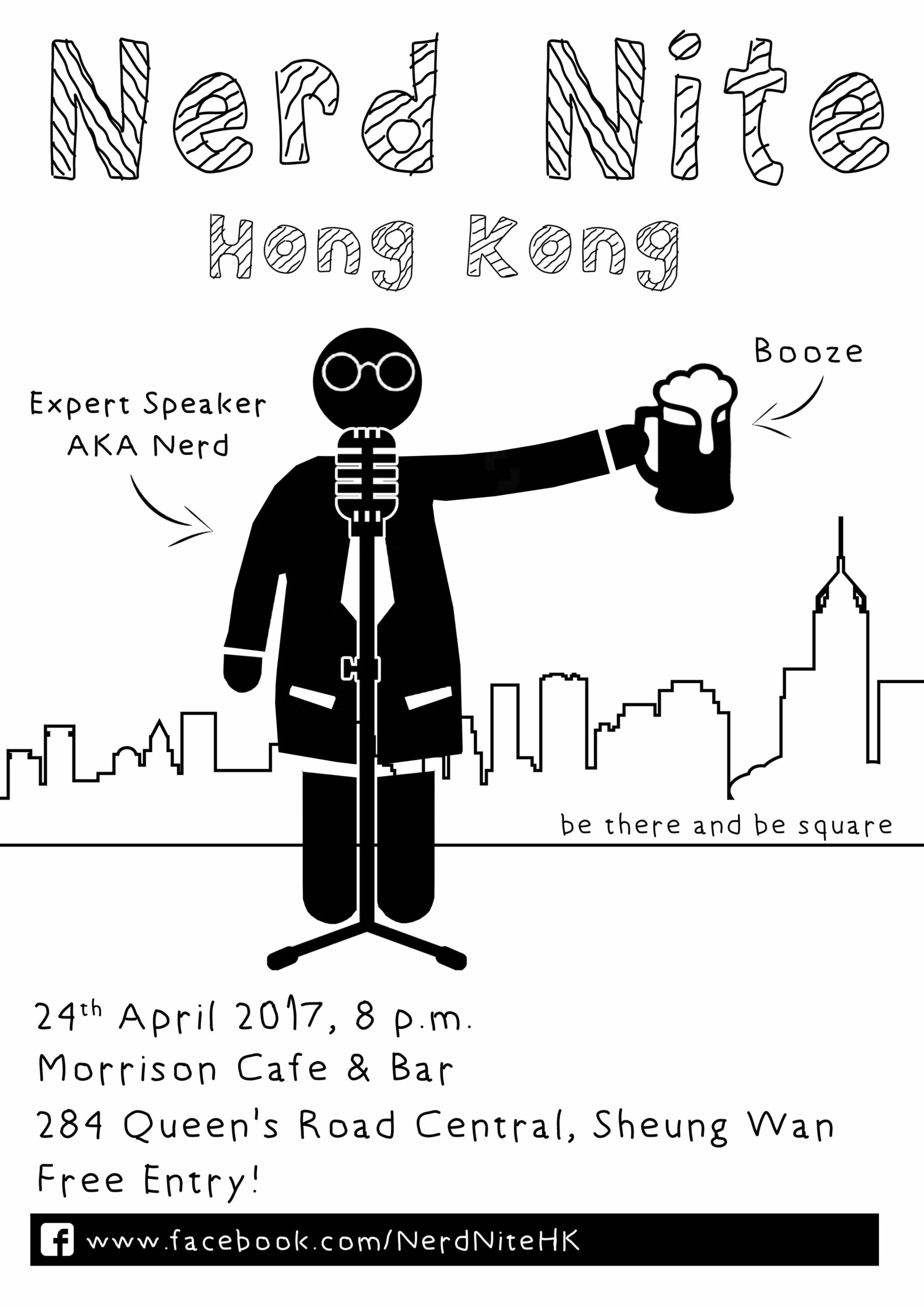
Event: Nerd Nite Hong Kong: Edition #5
Date: 28th August 2017
Time: 8:00 p.m.
Location: Mezcalito; 27/F, 18 On Lan St, Central.
Entry Fee: Free! Thanks to the support provided by the venue! You just got to buy your own drinks!
Speaker 1: Ms. Keisha Siriboe
Topic: Combining Social Good and Enterprise to improve Early Literacy Practices in Hong Kong
Quick Nerdisms: A supportive learning environment and an early start are crucial in shaping children’s literacy skills during early childhood (ages 0-5 years), however, for parents who do not speak English and/or cannot afford private tutoring, there are few mechanisms in place to help them provide an English language learning environment for their children. Stories of Us is a social enterprise that empowers parents to engage confidently in enjoyable early literacy activities. Keisha will share her experiences and the lessons she has learned as the Founder of Stories of Us, winner of the 2017 University of Hong Kong Dreamcatcher competition for entrepreneurship. This talk will honestly explore the highs and lows of being a social entrepreneur in Hong Kong.
Nerd Cred: Keisha Siriboe is a doctoral candidate studying English Language Education at the University of Hong Kong. Her published research focuses on early childhood literacy, parent education, access, and equity. For her dissertation, she is studying how parents in Hong Kong establish English language literacy skills with their children during early childhood. Before beginning her Ph.D. program, Keisha was the first African-American to graduate from Beijing Normal University with a Masters degree in Comparative Education in 2014.
Globally minded and service oriented, Keisha founded Stories of Us, a Hong Kong based social enterprise promoting enjoyable parent-child early literacy activities for 21st-century skills development. Stories of Us received the 2017 Dreamcatcher Award for Entrepreneurship from the University of Hong Kong. Keisha believes firmly in servant leadership and applies that model to her current positions as Chair of the American Educational Research Association (AERA) Graduate Student Council and representative for early career and doctoral students within the World Education Research Association (WERA)
Topic: Inspiring and Educating through Games
Quick Nerdisms: Learning through play, game-based education, experiential learning – all buzzwords that often surface in discussions about the future of education. “Gamification” solutions are popping up on the market, proclaiming to incentivize learning by creating “levels” for students to progress through and rewarding the completion of assignments. But do these solutions actually make learning fun? How do you design a memorable experience that puts fun first – and thus attract students to actually want to learn by themselves?
Press Start Hong Kong, a game design and education consultancy, is bringing a new interpretation of both topical knowledge and soft skills development – through analog games and immersive programs. Vince will share Press Start’s player-centric, fun-first game design approach to create experiences that inspire learners to self-driven exploration.
Nerd Cred: As Co-Founder and Managing Partner of Press Start Hong Kong, Vince is primarily responsible for business strategy, partnership development, PR and marketing. He works with partners and clients to create and run games-centric programs and new game experiences, and thrives on finding unique intersections between games and education to unlock the true potential of play.
Vince has a professional background in consulting and financial services, as well as years of experience in curriculum development and teaching across different age groups. He is also on the executive committee of TEDxWanChai, one of Asia’s most established TEDx chapters, and enjoys performing with his band around Hong Kong.
Speaker 3: Mr. David Nazer
Topic: An Insider’s Guide to Diamonds
Quick Nerdisms: An informal presentation on the world of diamonds; where they are from, how they are cut and why they are so rare and expensive
Nerd Cred: David Nazer is the co-founder and managing director of Haywards, one of Asia’s leading bespoke jewellers. Originally from London, David has spent most of his adult life in Asia, with just over 13 years in Hong Kong
Event: Nerd Nite Hong Kong: Edition #4
Date: 31st July 2017
Time: 8:00 p.m.
Location: Mezcalito; 27/F, 18 On Lan St, Central.
Entry Fee: Free! Thanks to the support provided by the venue! You just got to buy your own drinks!
Speaker 1: Prof. Cameron Campbell
Topic: Big Data for Chinese History
Quick Nerdisms: Just as big data is transforming our understanding of the contemporary world, it is also leading to a new understanding of the past. For China, results from analysis of novel big historical data both confirm and contradict longstanding assumptions about society and the economy. I will show how big data is transforming the study of Chinese history, with examples from an ongoing project to study the Qing civil service in its entirety, using a massive database of surviving personnel records
Nerd Cred: Cameron Campbell is Associate Dean for Research and Postgraduate Studies in the School of Humanities and Social Science at the Hong Kong University of Science and Technology. His research focuses on kinship, inequality, and demographic behaviour in China and in comparative perspective. With James Lee and other collaborators in the Lee-Campbell group, He has published on a wide variety of topics, including economic, family and social influences on demographic outcomes such as birth, marriage, migration, and death, fertility limitation in historical China, and the role of kin networks in shaping social mobility. With other members of the Lee-Campbell group, he is now conducting a study of the careers of government employees during the Qing by construction and analysis of a database of personnel and examination records. Before moving to HKUST in 2013, he was in the Department of Sociology at UCLA for 17 years. He originally earned his PhD at the University of Pennsylvania, and his Bachelor’s degree at the California Institute of Technology in 1989. He was awarded a Guggenheim Fellowship in 2004 and was named a Changjiang Scholar by the Ministry of Education of the People’s Republic of China in 2016, nominated by Central China Normal University. To learn more about his research, please see the website of the Lee-Campbell Research Group: https://www.shss.ust.hk/lee-campbell-group/
Speaker 2: Mr. Eric Byron
Topic: Juggling Tech Stacks – How to Keep Up With Technology Changes
Quick Nerdisms: Surviving in a tech career means constantly learning new skills and technology. Eric will share lessons learned in his 25+ years as a technologist, life-long learner, and fun seeker.
Nerd Cred: Eric has 25+ years of business and leadership experience in Information Systems and Technology. Eric has ~10 years of experience working in the video game industry. He has been living and working in Asia for 5 years and has extensive experience working for and with large multinational companies like Disney and Electronic Arts.
Speaker 3: Dr. Stuart Taylor
Topic: The Universe’s Missing Planets
Quick Nerdisms: Planets don’t form anywhere at random, but somehow pileup around favored periods (the time it takes the planet to go around the star). That was expected, but I have found a mysterious region right in the middle of the pileup where if the star has more planet-making material than the sun, there are no planets. This is really strange because it is where there should be the most planets, but there are none! There are planets in this period range for stars with less planet-making material, so does this mean that planet formation dislikes having too much material?
This case of the missing planets must be solved in order to understand how planets are formed. If we want to find life on other worlds, it is important to know where planets and their moons are — and where they are not.
Nerd Cred: Stuart Taylor has been studying exoplanet-related subjects since 1992, before the exoplanets that started the explosion of exoplanet research were found in 1995. This has led him to his most recent research, studying the distribution of planets by their periods, masses, and other parameters.
After obtaining his Ph.D. from BYU, he has studied the changing brightness of the sun at Caltech, and then measured features of the star Regulus with an array of telescopes called CHARA that can see features on the surfaces of stars with the highest resolution of any optical telescope in the world. Dr. Taylor set up the exoplanet observation program at a new worldwide observatory of globally linked telescopes.
Stuart “hot balls of gas” Taylor has lived in HK for five years where he often performs comedy and storytelling, where his funniest stories often come from saying the wrong words in Cantonese.
Nerd Nite Hong Kong is back in June, with a lineup of fantastic speakers talking about all kinds of nerdy goodness!
Event: Nerd Nite Hong Kong: Edition #3
Date: 26th June 2017
Time: 8:00 p.m.
Location: Mezcalito; 27/F, 18 On Lan St, Central.
Entry Fee: Free! Thanks to the support provided by the venue! You just got to buy your own drinks!
Speaker 1: Mr. Tom Champion
Topic: Hold my beer: A little taste of brewing science
Quick Nerdisms: Beer, glorious beer. Come grab a pint of liquid gold and hear about why beer has bubbles, how many buckets a brewer scrubs per annum, and everything in between. Wine drinkers welcome – albeit begrudgingly…
Nerd Cred: Tom Champion is Head Brewer at the Little Creatures Brewpub in Kennedy Town. He graduated in Chemical Engineering in his hometown of Perth in Australia, got bored of digging up rocks, and decided brewing beer might be more rewarding. Having worked with Little Creatures for the last 8 years at their three breweries, his passion for great beer has grown exponentially. Tom is now the Vice-President of the Craft Beer Association Hong Kong, and is eager to be a valuable contributor to the growing craft beer scene in Hong Kong.
Speaker 2: Dr. Benoit Guénard
Topic: What we know we know, what we know we don’t know, what we don’t know we know, what we don’t know we don’t know
Quick Nerdisms: The geographic and biological exploration of the world has for centuries driven humanity and lead explorers to land foot on remote continents, islands, the highest mountain peaks or to collect the most incredible, largest, or colourful specimens of animals and plants. At a time when most of the Earth surface is accessible from the same screen you are reading those lines, Humanity is now seeking to explore new planets, comets or the outer bound of our Solar System.
But in 2017, how much of life on Earth is known?
More than ever, while many ecosystems around the world are under siege by human activities, species discoveries and their conservation represent a major endeavour. However to protect biodiversity, one must first address these questions. What compose biodiversity? Where is it located? How many species are still unknown to Science? How the limitations in our knowledge impact our abilities to conserve biodiversity? After presenting a global perspective, I will focus more precisely on the situation in Hong Kong and use ants, my study-organism, as an example to illustrate what we know and what we don’t. Finally, I will introduce ways on how citizens can contribute directly to biodiversity research.
Nerd Cred: Dr. Benoit Guénard is an Assistant Professor of the University of Hong Kong since 2014. His research focuses on diversity patterns of ants, the mechanisms that drive their diversity for the past 100 million years, their roles within ecosystems – good or bad-, and in the development of tools that allow the identification of knowledge gaps and the increase of species discovery rate and conservation. He is leading the Global Ant Biodiversty Informatics project (GABI) and its associated online application www.antmaps.org; as well as the author of over 50 international scientific publications.
Speaker 3: Ms. Li Meng De Bakker
Topic: Opera: A Social Story
Quick Nerdisms: The social role of opera has continuously evolved since its emergence in 17th century Italy. Who frequented the opera house, and why? How did monarchs and, later, the nation state use opera as a political tool? Finally, what role does opera play in society today? The answer is a complex one, tracing the cultural, class and economic tides that shaped modern European history.
Nerd Cred: Li Meng de Bakker recently completed a master’s degree in music at the Chinese University of Hong Kong. As a freelance writer, she has interviewed musicians and conductors for local English print media. Her other music nerd credits include performing with the Hong Kong Bach Choir for 3 seasons, and supporting vocalists on the keyboard at live music venues in the city.
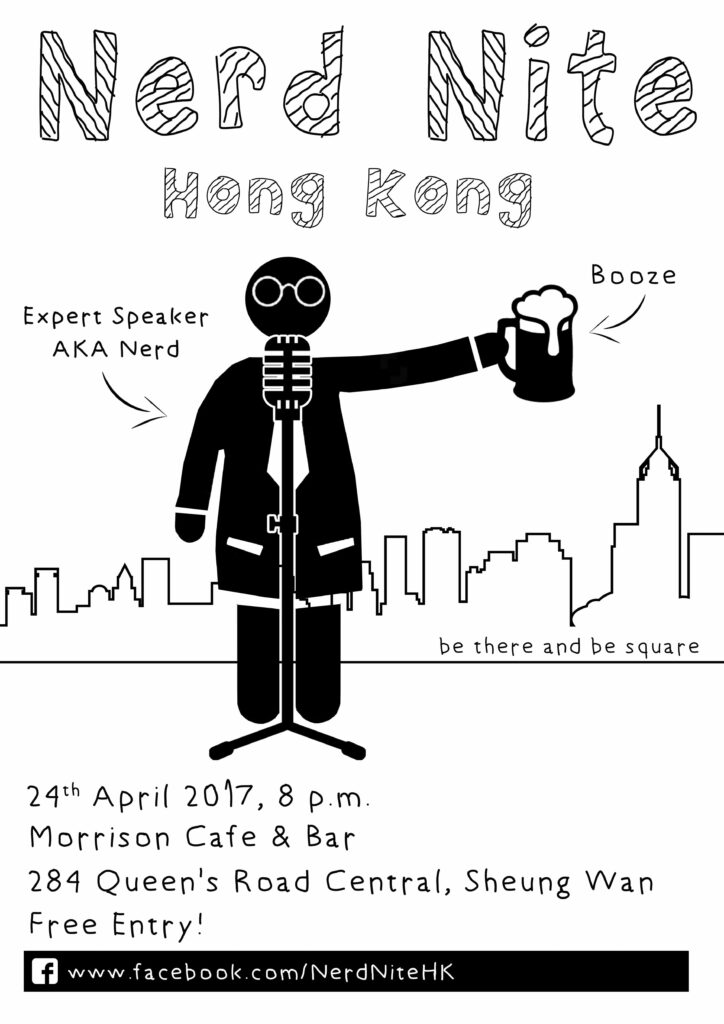
Nerd Nite is launching in Hong Kong!!! So knowledge! Much Beer! Very excite! Wow!
Event: Nerd Nite Hong Kong: Launch Edition
Date: 24th April 2017
Time: 8:00 p.m.
Location: Morrison Cafe & Bar; 284 Queen’s Road Central, Sheung Wan
Entry Fee: Free! You just got to buy your own drinks!
Speaker 1: Prof. Stephen Palmquist
Topic: What is Philosophy? And why must we all disagree
Quick Nerdisms: I argue that the most comprehensive way of defining philosophy is to regard it as the self-defining discipline. This definition holds in at least four senses. First, any attempt to define a discipline is by its very nature philosophical. Second, philosophy is therefore the only discipline for which the task of self-definition lies within the discipline itself. Third, the task of defining oneself, nowadays often thought of as related more to psychology than to philosophy, is also essentially philosophical, with psychology serving as a crucial but subservient light to guide the path. Fourth, recognizing the status of philosophy as essentially self-defining enables us to embrace the fact that there are as many different “definitions” of philosophy as there are philosophers; yet paradoxically, we can still regard philosophy as one and the same task throughout all these differences. I conclude with a summary of my own unique approach to defining philosophy, which divides philosophy into four distinct, one-word areas, with the purpose of each area being expressed as a two-word goal. This results in a surprisingly simple, twelve-word map of the philosophical path.
Nerd Cred: Stephen Palmquist (D.Phil., Oxford) is Professor of Religion and Philosophy at Hong Kong Baptist University, where he has taught since 1987. His 175+ publications (translated into 12 languages) include 11 books and 90+ refereed articles/chapters. In 1999 he founded the Hong Kong Philosophy Café, whose branches have over 900 members.
Speaker 2: Dr. Timothy Bonebrake
Topic: Butterfly urbanites: tales from Hollywood and Hong Kong
Quick Nerdisms: Urbanization globally has grown dramatically in recent decades. The consequences of urbanization for biodiversity and the world’s species could be substantial as natural habitats are paved over for housing and development. And yet, our cities are full of life! Using butterflies as an example, I will describe my research on the ecology of urban parks in cities over the past several years, with a focus on Los Angeles and Hong Kong. The lessons from this research give us insights into how humanity may be able to co-exist with other diverse species in cities.
Nerd Cred: Dr. Timothy C. Bonebrake is an Assistant Professor in the School of Biological Sciences at the University of Hong Kong. He received his BS at the University of California, Berkeley and PhD from Stanford University. Prior to moving to Hong Kong he held research positions at the University of California, Los Angeles and the University of California, Riverside. He has broad research interests in global change ecology and tropical conservation. Current and recent studies have focused on theoretical and empirical aspects of climate change impacts on biodiversity, with an emphasis on insects and Lepidoptera (butterflies and moths). His lab carries out research all over the world including Central Africa, Southeast Asia and North America. In Hong Kong he is studying biodiversity in urban areas and country parks examining the implications of these patterns for global change and conservation issues.
Speaker 3: Dr. Claire Lykou
Topic: “Cleaning dust” or an astronomer’s look at how stars die
Quick Nerdisms: Did you ever wonder why there is life on our planet? Have you thought about what we are made of? To put it nicely, we are all made of stardust! I will talk about the origins of stardust, where it comes from, how it is formed, what it looks like and how it arrived in our Solar system.
Nerd Creds: Dr. Claire Lykou is an astrophysicist and a Post-Doctoral Researcher at the Laboratory for Space Research of the University of Hong Kong. She studied physics at the University of Crete in Greece, and graduated with a PhD in astrophysics from the University of Manchester. Prior to moving to Hong Kong, she worked at the University of Vienna. She is an observational astronomer interested in stellar evolution, and especially how stars like the Sun evolve and die, and how they are replenishing the interstellar matter with material we can also find on Earth.